US Bill to sanction Russian oil
US Bill to sanction Russian oil: Why it could become not just India’s, but the world’s problem

WHY IN NEWS ?

The US Senate has voted 86-11 in favour of a Bill aimed at squeezing Russia’s oil and gas revenues. But it remains to be seen whether it will become law in its current form, given that it could further destabilise a global oil market already reeling from the West Asia crisis.
squeezing Russia’s revenue from oil and gas exports

The US Senate has voted 86-11 in favour of a Bill aimed at squeezing Russia’s revenue from oil and gas exports amid the war in Ukraine.
charging up to 100% tariffs

The Bill includes provisions for charging up to 100% tariffs on the top five buyers of Russian energy — and India is the second-biggest export market for Russian crude.
Sanctioning Russia and Iran Act of 2026
The Lindsey O. Graham Sanctioning Russia and Iran Act of 2026 —
a watered-down version of a proposed legislation initially backed by the late US senator and named after him — now moves to the House of Representatives, which reconvenes on August 31.
jeopardise the global oil market

It remains to be seen, however, whether the Bill will turn into law in its current form, considering that such a measure would jeopardise the global oil market
at a time when the West Asia crisis has already squeezed supplies.
India depends on imports

to meet over 88% of its crude oil needs, and Russia currently makes up over half of these imports.
What the new Bill proposes

The new version of the Bill proposes tariffs of up to 100% on the top five buyers of Russian oil and natural gas,
against the proposal of a blanket 500% tariff on buyers of Russian energy in the original version that had been hanging fire.
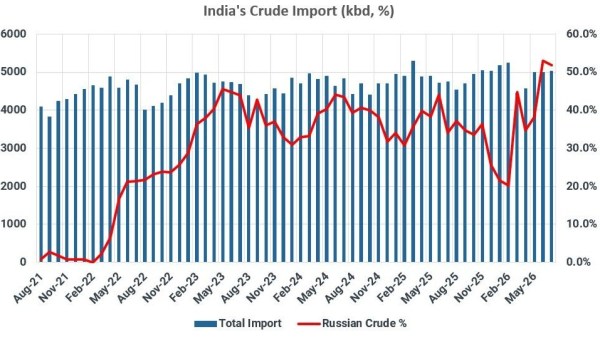 India’s oil imports. Russian oil makes up a significant chunk. Data source: Kpler
While this reduction in proposed tariffs appears meaningful on paper
the cap is still too high for India, which is also working to finalise a trade deal with the US.
Importantly, from New Delhi’s point of view, the new Bill does give powers to the US president to waive the application of its provisions.
For New Delhi, meaningfully reducing Russian oil imports

is just not an option in the prevailing circumstances of global energy supply tightness amid the West Asia crisis.
Even for Washington
taking away millions of barrels of Russian oil from the global market when energy flows from West Asia remain stifled wouldn’t be prudent.
That would worsen an already
- worrying supply situation
- would certainly send oil prices soaring,
- something that the Donald Trump administration wouldn’t want ahead of the midterm polls in the US later this year.
India’s challenge

Russia began offering discounts on its oil
With much of the West shunning Russian crude following the country’s February 2022 invasion of Ukraine, Russia began offering discounts on its oil , including Indian refiners.
This is how a peripheral supplier of oil to
- India became India’s biggest source of crude,
- displacing the traditional West Asian suppliers.

As per Kpler data
India’s Russian oil
- imports rose to 2.7 million barrels per day (bpd) in June-July,
- accounting for well over half of New Delhi’s total oil imports.
difficult to replace

Analysts say that despite the threat of sanctions, Russian crude remains the most practical and competitive source of supply for Indian refiners and is difficult to replace.
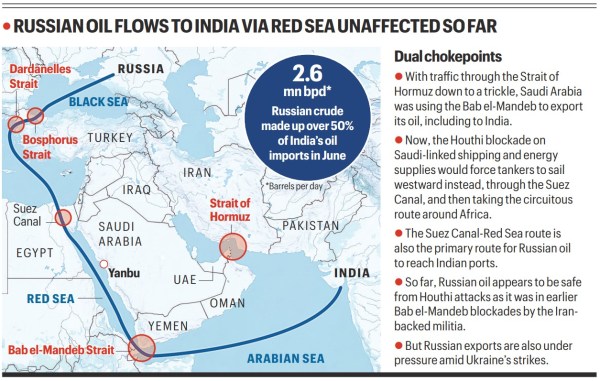 Russian oil
“The US Senate’s vote to advance tougher sanctions on Russia increases policy risk around Russian crude flows,

but does not change our near-term outlook for Indian or Chinese purchases,” said Sumit Ritolia.
legislative and administrative hurdles
“The measures still face further legislative and administrative hurdles, with the eventual impact depending largely on how aggressively the US administration chooses to
- implement them,
- use of exemptions
- or waivers.
policymakers retain an incentive
when physical supply security becomes a concern,
policymakers retain an incentive to avoid measures that could unnecessarily disrupt crude availability,” he said.
India would push for waivers

If the Bill does indeed become law, analysts say India would push for waivers.
“India would almost certainly push for it (waiver), and it would make sense for the US to agree as a friendly concession,
India-US trade talks - WILL BE AFFECTED

She added that the Bill “risks colliding” with the India-US trade talks. That would be counterproductive for both Washington and New Delhi, which have made progress in negotiations after initial setbacks and hiccups.
Viability of revised Russia sanctions bill

The big question now is will the bill be enacted in its current form, and if yes, when?
Energy market experts
are sceptical about the prospects for the proposed legislation, particularly in the context of
- market volatility
- stress due to the Strait of Hormuz crisis.
presidential waiver provision and other changes

in the bill provide enough room for the US government to make
- exceptions and
- navigate the prevailing situation more pragmatically even if the bill becomes law.
The question is whether this bill is economically real at all

I simply do not see this bill passing, or remaining in its current form.
1 . diluted from a 500%
Firstly, it has already been diluted from a 500% tariff threat against virtually all buyers of Russian oil and gas to a maximum of 100% aimed at only the five largest.
European exemptions and presidential waivers
have also been added. That tells you the political slogan is already being adjusted to economic reality,” Katona had said.
2. timing could not be worse

Trying to squeeze Russian oil out of the market during a renewed Gulf crisis would be dangerously explosive.
Brent CRUDE OIL / Brent oil (or Brent Crude)
is already trading above $85 per barrel, while traffic through the Strait of Hormuz has dropped sharply.
Removing or even threatening several million barrels per day of Russian supply at the same time would risk another price spike,” she added.
The original Bill sat in the US Senate for more than 15 months without action. The new one has cleared the first hurdle, but its fate in the House of Representatives remains to be seen.
SOURCE IE


Comments
Post a Comment