What are ‘Plastic’ notes and why do they matter?
RBI to introduce Polymer banknotes: What are ‘Plastic’ notes and why do they matter?

Knowledge Nugget: Polymer banknotes
Subject: Economy
Why in the news?
The Reserve Bank of India (RBI) plans to launch polymer banknotes at the beginning of next financial year (FY28), and people will initially get hold of lower denomination “plastic” notes, that of Rs 10 and Rs 20.
Key Takeaways:
Polymer notes have two purposes

One, it enhances the durability
This is relevant especially for the lower denominated notes with higher velocity. These notes have been in circulation for more than 30 years in various countries, and one finds that the life is much more, around 2-4 times the life of the paper currency,” Malhotra said at the central bank’s post monetary policy press conference.
“The second purpose is to expand our capacity
as the needs of the economy increase,” he said. The new notes will be checked for durability and adaptability to Indian conditions before the RBI clears it for circulation.
The project will begin with the lower denomination notes

of Rs 10 and Rs 20 which have “higher velocity” to change hands, and thus are prone to more wear and tear.
The RBI’s trial of plastic notes will see
- 100 crore pieces of Rs 10 and Rs 20 notes each being introduced,
- totaling Rs 3,000 crore.
The central bank’s subsidiary Bharatiya Reserve Bank Note Mudran Private Limited had last month floated a global tender for 3.4 crore polymer sheets for the same purpose.
Where are plastic notes adopted?

First issued by Australia in 1988
plastic banknotes are now used in more than 50 countries and are widely considered to be far superior to paper ones.
6. Among developed countries, the likes of the
- UK,
- Canada,
- New Zealand use polymer notes.
- Thailand, Vietnam, Malaysia, and Singapore also use plastic currency, albeit not exclusively / IS TRUE
What are the benefits of using plastic notes?

7. The biggest advantage plastic notes provide over paper notes is that they are
- far more durable,
- lasting anywhere between 2 TO 6 times longer depending on the denomination of the note (small denomination notes are handled more frequently, which reduces their life).
- And this longer life is the source of nearly all the benefits.
One, a longer life means
- fewer plastic notes need to be manufactured over any period of time.
- printing fewer notes reduces costs related to making them —
- even though one plastic note is more expensive to make than a paper one —
- distributing them and destroying them. And the elimination of these costs has a favourable impact on the environment.
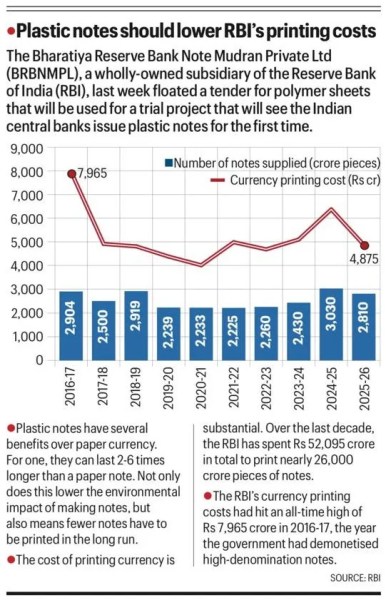 RBI’s cost of printing currency.
carbon footprint of cotton-based currency notes and plastic

Back in August 2013, the RBI had said it had asked The Energy and Resources Institute (TERI) to conduct a study on the carbon footprint of cotton-based currency notes and plastic ones over their entire lifetime.
This ‘Life Cycle Impact Assessment’ came to the conclusion that replacing cotton-based notes with plastic ones would have “significant environmental benefits”.
granulated and recycled

“Polymer/plastic banknotes (and the waste from production) can be granulated and recycled into useful plastic products such as
- compost bins,
- plumbing fittings
- and other household and industrial products.
- The base material of polymer - is a non-renewable resource, but due to its recyclability, it has more than one life,” the RBI had said.
There is also the security advantage

According to British firm De La Rue, which supplies notes to more than half of all central banks, plastic notes are more secure as most counterfeit notes are produced on paper.
As such, counterfeit rates have fallen in countries where currency notes are made of polymer.
But what’s the concern?
import OF sheets

Despite all the positives of plastic notes, one issue remains: the possibility that India WILL import the sheets that are used to print banknotes.
Pakistan or China

raw materials
While the tender expressly said bidders must ensure that their operations in Pakistan or China, if any, must be “suitably firewalled” from those in India,
no raw materials be procured from these two countries,
no employee
who has previously worked or been posted or is citizen or person with origins in these countries be engaged for the India project, depending on a foreign entity for your legal tender is a vulnerability.
What is legal tender? and where are bank notes and coins produced/minted?

Legal Tender
is a coin or a banknote that is legally tenderable for discharge of debt or obligation.
The coins
issued by Government of India under Section 6 of The Coinage Act, 2011, shall be legal tender in payment or on account provided that a coin has not been defaced and has not lost weight so as to be less than such weight as may be prescribed in its case.
Coin of any denomination not lower than one rupee
shall be legal tender for any sum not exceeding one thousand rupee in any single transaction.
Fifty paise (half rupee)
coin shall be legal tender for any sum not exceeding ten rupee. While anyone cannot be forced to accept coins beyond the limits mentioned above, voluntarily accepting coins for amounts exceeding the limits mentioned above is not prohibited.
Every banknote issued by Reserve Bank of India
sub-section (2) Section 26 of RBI Act
NOTE TILL withdrawn from circulation, shall be legal tender at any place in India in payment or on account for the amount expressed therein, and shall be guaranteed by the Central Government,
subject to provisions of sub-section (2) Section 26 of RBI Act, 1934. ₹1 notes issued by Government of India are also Legal Tender.
5. Banknotes in India are currently being issued in the denomination of ₹10, ₹20, ₹50, ₹100 ₹200, and ₹500.
These notes are called banknotes as they are issued by the Reserve Bank of India.
denominations of ₹2 and ₹5
The printing of notes in the denominations of ₹2 and ₹5 has been discontinued
and these denominations have been coinised as the cost of printing and servicing these banknotes was not commensurate with their life.
However, such banknotes issued earlier can still be found in circulation and these banknotes continue to be legal tender.
Where are bank notes and coins produced/minted?

7. Bank notes are printed at four currency presses
two of which are owned by the Government of India through its Corporation
- Security Printing
- Minting Corporation of India Ltd. (SPMCIL)
two are owned by the Reserve Bank
through its wholly owned subsidiary, Bharatiya Reserve Bank Note Mudran Private Ltd. (BRBNMPL).
8. The currency presses of SPMCIL are at
- Nasik (Western India) and
- Dewas (Central India).
Coins are minted in four mints
owned by SPMCIL. The mints are located at
The coins are issued for circulation only through the Reserve Bank in terms of Section 38 of the RBI Act.


Comments
Post a Comment