Colombia quake toll crosses 200, count of missing over 3,000

Do You Know:
• The epicenter of the quake

according to the U.S. Geological Survey, was about three miles east of San José del Palmar — a town of about 5,000 people in the Chocó region, one of the poorest parts of Colombia.
The temblor / earthquake. , which struck about 7:34 a.m. local time, rattled much of the country, though the impact was worst in cities and towns in the foothills of the Andes.
• Colombia sits

it cits along the seismically active Pacific Ring of Fire, a major horseshoe-shaped basin around the Pacific Ocean where tectonic plates collide and interact.
This geologically volatile setting results from the
subduction and movement of major plates

such as the Nazca Plate beneath the South American Plate.
• Ring of Fire

—the Ring of Fire is a string / chain of volcanoes and sites of seismic activity, or earthquakes, around the edges of the Pacific Ocean.
Roughly 90 percent of all earthquakes occur along the Ring of Fire, and the ring is dotted with 75 percent of all active volcanoes on Earth.
—The Ring of Fire isn’t quite a circular ring.
It is shaped more like a 40,000-kilometer (25,000-mile) horseshoe.
A string of 452 volcanoes stretches from the
- southern tip of South America,
- up along the coast of North America,
- across the Bering Strait,
- down through Japan,
- and into New Zealand.
- Several active and dormant volcanoes in Antarctica, however, “close” the ring.
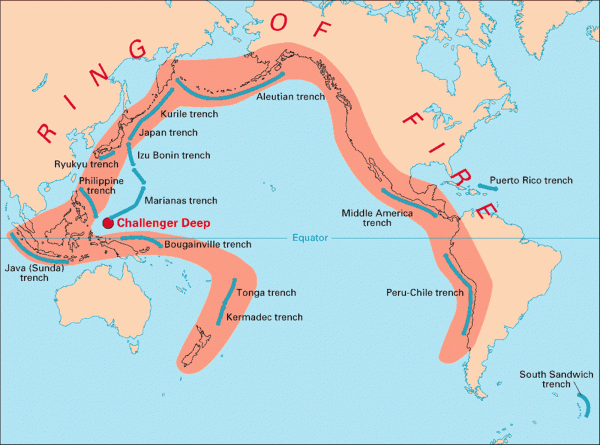 The map of the Pacific Ring of Fire. (Credit: USGS)
Volcanic arcs and oceanic trenches
partly encircling the Pacific Basin form the so-called Ring of Fire. The trenches are shown in blue-green.
The volcanic island arcs, although not labelled, are parallel to, and always landward of, the trenches.
For example, the island arc associated with the Aleutian Trench is represented by the long chain of volcanoes that make up the Aleutian Islands. (Source: W. Jacquelyne and Robert I. Tilling via USGS)[/caption]
—The Ring of Fire is the result of plate tectonics.
Tectonic plates are huge slabs of Earth’s crust, which fit together like pieces of a puzzle.
The plates are not fixed but are constantly moving atop a layer of solid and molten rock called the mantle.
Sometimes these plates collide, move apart, or slide next to each other. Most tectonic activity in the Ring of Fire occurs in these geologically active zones.
—The Andes Mountains of South America
run parallel to the Peru-Chile Trench, created as the Nazca Plate subducts beneath the South American Plate.
The Andes Mountains include the world’s highest active volcano, Nevados Ojos del Salado, which rises to 6,879 meters (over 22,500 feet) along the Chile-Argentina border.
Many volcanoes in Antarctica are so geologically linked to the South American part of the Ring of Fire that some geologists refer to the region as the “Antarctandes.”


Comments
Post a Comment