India’s first guide to grasslands
India’s first guide to grasslands: Why it matters

India has unveiled its first-ever Guide to Grasslands and Other Open Natural Ecosystems—but what makes this guide significant? Why are grasslands important? Also, go 'Beyond the Nugget' to know about India’s second progress report on the Bonn Challenge.
India’s first-ever guide to grasslands and other open natural ecosystems
Subject: Environment
Why in the news?

Recently, India launched its first-ever Guide
to Grasslands and Other Open Natural Ecosystems (ONEs) of India at the 17th Session of the Conference of the Parties (COP17) to the United Nations Convention to Combat Desertification (UNCCD) in Ulaanbaatar, Mongolia. In this context, let’s know what the key highlights of it and the significance of grasslands are.
Key Takeaways:
1. India’s Guide to Grasslands and ONEs

marks an important step in the direction of strengthening their
- conservation,
- restoration,
- sustainable management.
2. It highlights the
- rich diversity,
- ecological significance,
- and socio-economic importance of India’s grasslands and other open natural ecosystems.
3. It brings together
information on major ONEs across India, covering their
- geographical settings,
- ecological characteristics,
- biodiversity,
- communities and tribes associated with them.
- It also contains sections on - pastoralism, fire ecology, and carbon sequestration.
4. The minister for environment, forest, and climate change, Bhupender Yadav,

described the guide as an important step towards recognizing India’s open natural ecosystems and stressed the need for their science-based conservation alongside forests.
5. Notably, India’s ONEs range from
- Himalayan and Terai grasslands to the
- Thar and Banni landscapes -
बन्नी लैंडस्केप्स (Banni Landscapes) का हिंदी अर्थ "बन्नी के भूदृश्य" या "बन्नी घास के मैदानों का प्राकृतिक क्षेत्र" है। यह गुजरात के कच्छ जिले में स्थित एशिया के सबसे बड़े और अनूठे शुष्क घास के मैदानों (Arid Grasslands) के पारिस्थितिक तंत्र (Ecosystem) को संदर्भित करता है।, - rocky plateaus,
- ravines खड़े पार्श्वों वाली गहरी संकरी घाटी दर्रा ,
- scrublands झाड़ीदार भूमि:,
- Deccan savannas,
- coastal ecosystems, and
- desert landscapes.

6. The Guide will serve as a valuable resource for
- policymakers,
- researchers,
- conservation practitioners,
- development agencies,
- and communities working towards the conservation, restoration, and sustainable management of India’s grasslands and other ONEs.
Why are grasslands so important?

1. Grasslands — home to the great Poaceae family
पोएसी (Poaceae) कुल, जिसे पुराना नाम ग्रैमिनी (Gramineae) भी कहते हैं, एकबीजपत्री (Monocot) पौधों का घास परिवार है। यह मानव जीवन और कृषि के लिए सबसे महत्वपूर्ण पादप कुल है, जिसमें चावल, गेहूं, मक्का, और गन्ने जैसी मुख्य खाद्य व नकदी फसलें शामिल हैं
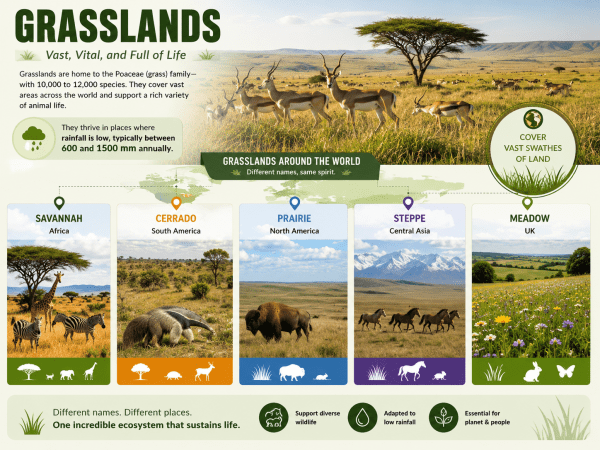
with its 10,000 to 12,000 members or species — cover vast swathes of landmass throughout the world and support a wide variety of animal life.
They thrive in places where the rainfall is low, typically between 600 and 1500 mm annually.
2. They provide a host of ecosystem services —
storing water and carbon, recycling chemicals, and controlling the climate.
3. In India, almost a quarter of the landmass is covered in grassland.

This includes the
- alpine meadows of the Himalayas,
- the chaurs in the foothills,
- the famous terai grasslands in the flood plains of the Ganges and Brahmaputra,
- the phumdis,
- quivering wet grasslands of Manipur (where the deer “dance”),
- the savannas of western and peninsular India
- and the renowned “sholas” of the Western Ghats.
4. Different names are used in the world

to refer to grasslands. According to World Wide Fund for Nature (WWF), it is known as
- ‘savannah’ in Africa,
- ‘cerrado’ in South America,
- ‘prairie’ in North America,
- ‘steppe’ in central Asia,
- and ‘meadow’ in the UK.
World Day to Combat Desertification and DroughtJune 17 is observed as the World Day to Combat Desertification and Drought under the UNCCD. The day serves as a global platform to raise awareness and promote action against desertification, land degradation and drought. The theme for this year is “Rangelands: Recognize. Respect. Restore.” Notably, the UN has declared 2026 as the International Year of Rangelands and Pastoralists (IYRP). |
India’s Second progress report on the Bonn Challenge
1. India has restored 21.7 million hectares
of degraded and deforested land between 2011 and 2020,
according to the country’s second progress report on the Bonn Challenge
released by the Ministry of Environment, Forest and Climate Change and the International Union for Conservation of Nature (IUCN) on 17th June, 2026.
This includes restoration through planted forests, natural regeneration, silviculture, agroforestry, and mangrove restoration.
2. The Bonn Challenge
is a global initiative launched in 2011, with the efforts of the Government of Germany and IUCN. IUCN acts as the Secretariat of the Bonn Challenge.
3. The Bonn Challenge makes a commitment
to restoring 150 million hectares of degraded and deforested landscapes by 2020, and an additional target of 350 million hectares by 2030.
4. The Bonn Challenge is a direct contribution
to the UN Decade on Ecosystem Restoration.
It offers a practical way of achieving
- international commitments,
- including the Sustainable Development Goals (SDGs),
- Aichi Biodiversity Targets of the Convention on Biodiversity (CBD),
- and the Paris Agreement
India’s Bonn Challenge pledge


Comments
Post a Comment