indigenous ‘Netra’ Airborne Early Warning and Control
Netra AEW&C – India’s indigenous ‘eye in the sky’
Subject: Defence
Why in the news?

The indigenous ‘Netra’ Airborne Early Warning and Control (AEW&C) system achieved a significant milestone with the handing over of the Final Operational Clearance (FOC) to the Indian Air Force (IAF) by the Defence Research & Development Organisation (DRDO).
Clearance (IOC) in October 2017

The clearance was awarded nearly eight years after Netra got Initial Operational Clearance (IOC) in October 2017, marking a notable step towards Aatmanirbhar Bharat in advanced aerospace and defence technologies.
Key takeaways:
1. The airborne radar and command centre

will be an ‘eye in the sky’ for India — designed to detect incoming
- missiles,
- ships and
- planes from a long distance.
- It can provide real-time information for effective decision-making during crises.
2. According to DRDO, the AEW&C System consists of sensors mounted on an aircraft

for locating and providing
- early warning of airborne & sea surface targets
- hostile emissions.
- The System also provides comprehensive information to the controllers on board the aircraft as well as to the ground stations.
3. The indigenous system has been in the works for nearly two decades, receiving its initial operation clearance in 2017.

4. Netra is equipped with an indigenously developed Active Electronically Scanned Array (AESA) radar

in an Active Antenna Array Unit (AAAU) providing 240° radar coverage and detecting low-flying threats up to 375 km while mounted on two Embraer EMB-145 jets.
5. The IAF also operates three Phalcon Airborne Early Warning and Control systems

— integrating Israeli EL/W-2090 radar technology atop Russian Ilyushin Il-76 heavy-lift planes.
These have a slightly higher range, providing 360-degree surveillance and tracking airborne targets up to 500 km.
6. The Deputy Chief of the Air Staff, during the ceremony

confirmed that Netra AEW&C was used during Operation Sindoor and Balakot strikes. The FOC is a step towards confirming that Netra has completed the required tests, changes, checks and approvals for its final accepted form.
How did the IAF strike the Jaish-e-Mohammad terror camp at Balakot?

1. In retaliation for the Pulwama terror attack of February 14, 2019, the IAF carried out a well-planned attack on the Jaish-e-Mohammad terror camp at Balakot on February 26, 2019 under the code-name Operation Bandar.
2. In the early morning of 26th February, IAF’s French origin Mirage-2000 fighter jets fired precision-guided munitions at the target location.
These jets have a
- night vision-capable glass cockpit,
- upgraded navigation and
- IFF (identify friend or foe) systems,
- advanced multi-mode multi-layered radar, and a fully integrated electronic warfare suite.
.
The Israeli-built Popeye is a medium-range conventional missile that can be fired from a stand-off distance of around 90 km, i.e., the aircraft doesn’t need to be vertically above the target to hit it. SPICE (Smart Precise Impact and Cost Effective guidance kit)-2000  is a forward and tail kit evolved by Israel from the Popeye missile, mounted on a standard 2000-pound Mk 84 unguided bomb. |
Integrated Air Command and Control System (IACCS)

1. During Operation Sindoor, IACCS of the Indian Air Force brought all these elements together, providing the net-centric operational capability vital for modern warfare.
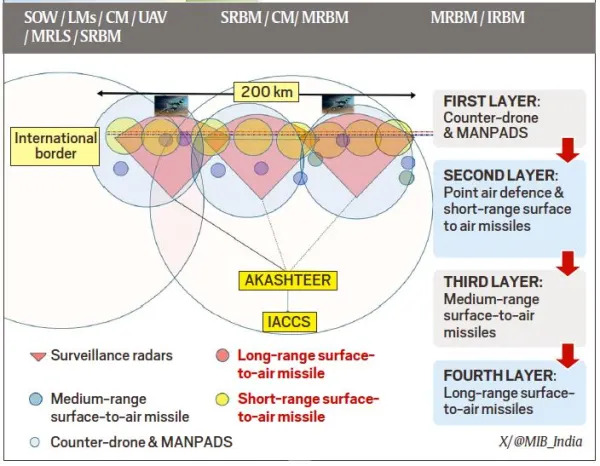
2. Developed by

the public sector aerospace and defence electronics company Bharat Electronics Limited (BEL)
IACCS is an automated command and control system that integrates data from
- all air defence assets,
- including ground-based radar,
- airborne sensors,
- civilian radar,
- communication nodes,
- and the various command and control centres of the IAF.
3. comprehensive picture and overall situational awareness

The availability of the
- consolidated dataset,
- real-time updates,
- provides military commanders at multiple levels with a comprehensive picture and overall situational awareness during air operations
- they can respond to a wide range of aerial threats.
4. The overlapping radar and radio data coverage of the IACCS helps in effective airspace management and reduces redundancy.
5. The Indian Army has a similar air defence control and reporting system called Akashteer, which connects the units of its air defence.
SOURCE IE


Comments
Post a Comment