India USA trade deal
India-US trade talks are nearing the finish line

India-US trade talks:

As US Trade Representative (USTR) Jamieson Greer leads his first trade delegation to India after over a year of negotiations, the two countries appear to be closer than ever to finally completing their trade deal.
Carrot and stick approach

Greer, in an op-ed last year, wrote that US President Donald Trumpuniquely recognises that the privilege of selling into the world’s most lucrative consumer market is a “mighty carrot” and a tariff is a “formidable stick”.
America’s approach to trade deals across the globe and the timing of USTR’s visit to India encapsulates this carrot-and-stick approach.
The US had imposed sweeping reciprocal tariffs

on several countries last year under a rarely-used legislation called the International Emergency Economic Powers Act (IEEPA).
In February, however, the US Supreme Court struck down these reciprocal tariffs, prompting the administration to use alternative legislation to resurrect its tariff policy.

One of these pieces of legislation was under Section 122, which gives the US authority to impose 10% tariffs for 150 days.
These are now set to lapse on July 24 — when Washington is expected to introduce a new, steeper tariff architecture under Section 301 of the US Trade Act of 1974.
The last leg of India-US talks
12.5 % already proposal and Section 301

The final stretch of the India-US talks come right before this. The US has already proposed 12.5% tariffs on
India and is expected to release the findings of its second Section 301 investigation on India and 15 other countries well before July 24.
India is among the handful of countries with whom the US is yet to formally sign a trade deal. It has already sealed deals with nearly a dozen trade partners, including the
- EU,
- Japan,
- South Korea
- and several ASEAN countries.
US has been seeking
deeper access into Indian markets, New Delhi has demanded a competitive edge in the tariff rates in Washington’s new Section 301 architecture,
along with assurances that no further Section 301 tariff will be opened against India following the deal.
target countries ?
The US has opened three target Section 301 investigations in Vietnam. China also remains a key Section 301 target.
India is primarily worried about a

surge in US agricultural products which receive far higher government support compared to incentives given in India.
From the US perspective, the talks are aimed at protecting and reviving its industrial base.
imports of tech products

India, meanwhile, is concerned that high-value imports of tech products will increase, eroding the already shrinking goods trade surplus. Overall, India runs an annual goods trade deficit of over $300 billion.
Narrowing trade surplus

The US imposed 50% tariffs on India in August — 25% was retaliatory and the rest was linked to Russian oil purchases. This made India the worst hit country.
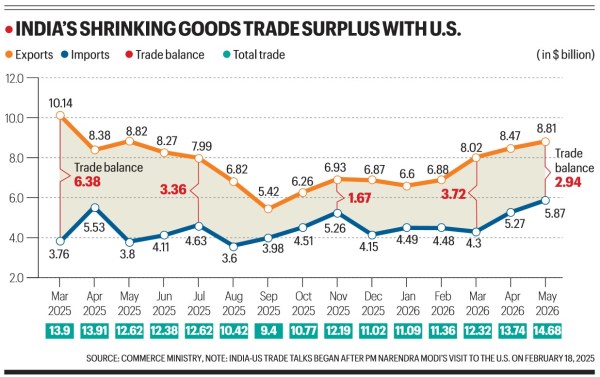
India’s export surplus with the US

has been declining owing to the steep reciprocal tariffs that were in place for nearly six months (see chart).
Data released by the Commerce and Industry Ministry showed that
- India’s export surplus slipped over 40% from $5.02 billion in May 2025
- to $2.94 billion in May this year.
deficit with nine of its ten
The declining surplus is concerning for India as New Delhi runs a goods trade deficit with nine of its ten top trading partners.
India export more than import to USA
The US is the only major economy to which India exports more than it imports.
Besides, India’s dependence on the US market has gone up over the last decade. According to official data, the
- US now accounts for nearly 20% of India’s total exports,
- compared to 10% in 2010-2011.
India’s petroleum product exports to the US

in March
- this year slipped by 24.02% to $235.47 million compared
- to $309.91 million.
- went up by 130.95% to $321.73 million in March 2026
- compared to $139.31 million during March last year.
Another high-volume product category

where US imports have been gaining ground is electronic components.
While India’s exports of electronic components in March
- this year slipped by 33.41% from $203.54 million to $135.54 million
- this year, India’s imports under this category jumped by 136.30% to $431.89 million in March 2026 compared to $182.77 million in March 2025.
Farm groups

have expressed fear over an influx of US agri imports.
Rakesh Tikait, national spokesperson of the Bhartiya Kisan Union, said in a letter to PM Narendra Modi that in the absence of
- adequate tariff protection,
- farmers engaged in growing these agricultural products would not be able to compete with subsidised imports from the US.
‘
Tough nut to crack’

Greer has been critical of India’s position, saying it had been a “difficult nut to crack”, highlighting
- differences in agriculture negotiations;
- the US had received the “best offer” from India.
non-tariff barriers across sectors in India

In a detailed report prepared by his department, Greer pointed out non-tariff barriers across sectors in India, which are hurting US companies trying to export.
“There’s resistance in India to certain row
- crops and
- other meats and products.
.
SOME CONCERN
The result of the talks with Commerce Minister Piyush Goyal assumes significance as several investors are holding on to
- capex investment,
- awaiting Washington’s new tariff architecture.
For India, a slowdown in investments has resulted in a rapidly weakening currency.
India saw gross Foreign Direct Investment inflows

rise to a new record of $94.53 billion in 2025-26, up 17% from the previous year, although the net figure was a mere $7.65 billion, RBI data showed.
Inflows had risen sharply in February on the back of global investor sentiment reversing in the wake of the signing of an interim trade deal between India and the US early that month,
- which eliminated the penal 25% tariff and
- reduced the reciprocal tariff to 18% from 25%.
Foreign Portfolio Investors had also net bought Indian financial assets in February to the tune of $4.17 billion.
However, once the West Asia war began at the end of February, foreign capital exited Indian shores in droves: $13.6 billion in March, $7.56 billion in April.
Greer: China, free trade sceptic

Greer has long believed that China stole American intellectual property rights (IPR) to build a manufacturing base in China, which resulted in the loss of American jobs and that “Chinese ambitions are an existential threat to the US”.
“
According to his testimony, Greer believes the US must find a constructive way to coexist with China, which will involve continued trade in certain sectors.
“But everyone needs to work from a set of common facts to develop good policy responses,” he said.
Source IE


Comments
Post a Comment