SC panel frames ICU norms for hospitals

An expert committee formed by Supreme Court
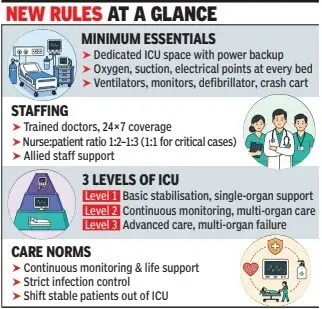
has laid down - minimum standards for intensive care units (ICUs),
- defining what hospitals must have to qualify as possessing an ICU - covering
- infrastructure,
- equipment
- staffing.
The framework mandates
a dedicated - ICU space - with access to
- emergency services,
- operation theatres and
- laboratories,
- power backup,
- sanitation
- proper layout.
Bedside essentials include -
- oxygen,
- suction and electrical points,
- equipment - monitors, ventilators,
- defibrillators - delivers an electrical shock to the heart to restore a normal rhythm during cardiac arrest

- crash carts

- infusion and syringe pumps,
- glucometers - Glucometers are portable medical devices used to measure blood sugar (glucose) concentration,
- ECG machines.
Staffing / GUIDELINE
trained doctors
Staff is central to the norms. ICUs must be led by trained doctors and be manned round the clock,
nurse-to-patient ratios
with higher nurse-to-patient ratios than in wards - ranging from
- 1:2
- 1:3
- 1:1 for critically ill or ventilated patients - supported by allied healthcare staff.
The guidelines also emphasise
- continuous monitoring,
- life-support systems
- strict infection control protocols as essential to ICU care.
ABOUT REPORT
The norms are part of "Guidelines for the Organisation and Delivery of Intensive Care Services", a report drafted by a three-member committee
and vetted by medical experts, and endorsed by the court as "practical, implementable and necessary as a minimum standard for an ICU".
A bench of Justices Ahsanuddin Amanullah and R Mahadevan has asked states and Union territories to submit action plans identifying gaps and implementation strategies by May 18.
The Supreme Court-appointed panel - comprising - AIIMS doctor Nitish Naik,
- additional solicitor general Aishwarya Bhati
- and advocate Karan Bharioke - has said clinical judgment should guide decisions on the level of care required.
COMMENTS FROM MEDICAL
Dr Harsh Mahajan
chairman of Mahajan Imaging Lab and one of the experts who vetted the guidelines, said it recognises - gaps in rural and remote areas
- suggests measures such as - interim staffing norms and linking smaller ICUs with higher centres through e-ICU or tele-ICU support.
Dr Saumitra Rawat of Sir Ganga Ram Hospital
said, "The new guidelines - classify ICUs into levels,
- making it mandatory for even entry-level units to meet defined norms," he said.
SOURCE THE HINDU
An expert committee formed by Supreme Court
has laid down
- minimum standards for intensive care units (ICUs),
- defining what hospitals must have to qualify as possessing an ICU - covering
- infrastructure,
- equipment
- staffing.
The framework mandates
a dedicated
- ICU space - with access to
- emergency services,
- operation theatres and
- laboratories,
- power backup,
- sanitation
- proper layout.
- oxygen,
- suction and electrical points,
- equipment - monitors, ventilators,
- defibrillators - delivers an electrical shock to the heart to restore a normal rhythm during cardiac arrest
- crash carts
- infusion and syringe pumps,
- glucometers - Glucometers are portable medical devices used to measure blood sugar (glucose) concentration,
- ECG machines.
Staffing / GUIDELINE
trained doctors
Staff is central to the norms. ICUs must be led by trained doctors and be manned round the clock,
nurse-to-patient ratios
with higher nurse-to-patient ratios than in wards - ranging from
- 1:2
- 1:3
- 1:1 for critically ill or ventilated patients - supported by allied healthcare staff.
- continuous monitoring,
- life-support systems
- strict infection control protocols as essential to ICU care.
ABOUT REPORT
The norms are part of "Guidelines for the Organisation and Delivery of Intensive Care Services", a report drafted by a three-member committee
and vetted by medical experts, and endorsed by the court as "practical, implementable and necessary as a minimum standard for an ICU".
A bench of Justices Ahsanuddin Amanullah and R Mahadevan has asked states and Union territories to submit action plans identifying gaps and implementation strategies by May 18.
The Supreme Court-appointed panel -
comprising
- AIIMS doctor Nitish Naik,
- additional solicitor general Aishwarya Bhati
- and advocate Karan Bharioke - has said clinical judgment should guide decisions on the level of care required.
COMMENTS FROM MEDICAL
Dr Harsh Mahajan
chairman of Mahajan Imaging Lab and one of the experts who vetted the guidelines, said it recognises
- gaps in rural and remote areas
- suggests measures such as - interim staffing norms and linking smaller ICUs with higher centres through e-ICU or tele-ICU support.
Dr Saumitra Rawat of Sir Ganga Ram Hospital
said, "The new guidelines
- classify ICUs into levels,
- making it mandatory for even entry-level units to meet defined norms," he said.
SOURCE THE HINDU


Comments
Post a Comment