Maharashtra drought crisis 2026
Behind Maharashtra drought crisis, sharp regional variation in rainfall

Arhar, chana prices are rising, but the real pinch may be felt in the rabi season, if farmers avoid sowing chana and jowar due to the lack of moisture in soil, depleted reserves
- moderate drought (25-50% rainfall deficit)
- severe drought (over 50% deficit). Such droughts have serious impacts on agriculture, water availability, and society....

Drought can be classified based on its impact on
- rainfall,
- agriculture,
- water resources, and
- society.
- Each type develops differently and affects communities in various ways.
drought in about three-fourths of the state

The Maharashtra government on Saturday declared drought in about three-fourths of the state (265 of its 358 tehsils). The state has recorded a rainfall deficit of 18% this year.
But the rainfall over Maharashtra this monsoon season has not been drastically different from other states so far. The country as a whole has a 13% rainfall deficit compared to its 18%.
Many other states — including Assam and Bihar, which have also experienced floods this season — have much bigger deficits.
What may explain the situation in Maharashtra, however, is the large regional variation in rainfall within the state.
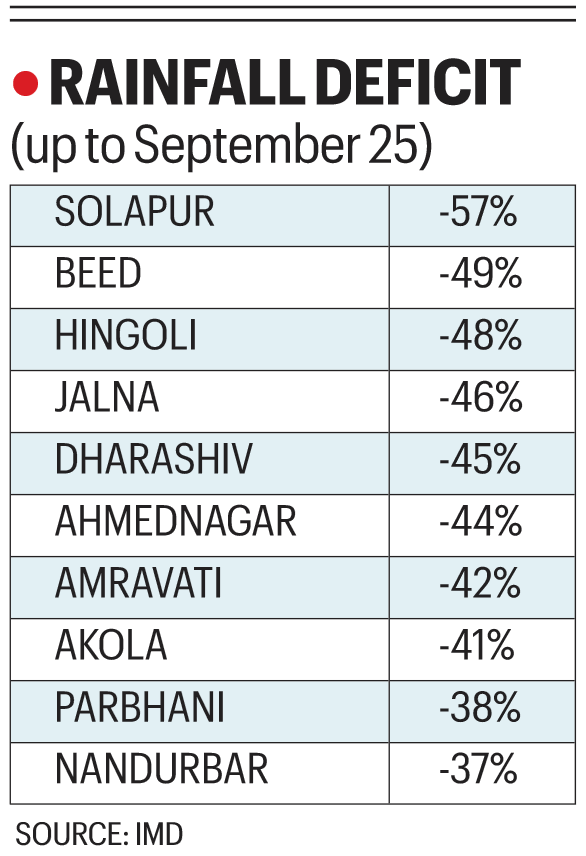
The worst-hit areas

Marathwada and Vidarbha
the two rain-shadow regions of the state which traditionally are drought-prone, have received very little rainfall.
Marathwada is particularly affected, having received 38% less rainfall than normal, while Vidarbha has a 27% deficiency.
The big deficit is in seven districts — Solapur, Dharashiv, Latur, Hingoli, Jalna, Beed and parts of Nanded, which are away from Godavari river — where rainfall has been just around 50% of normal.
Except Solapur, all these districts fall in Marathwada region. Vidarbha region is a little less affected, while western Maharashtra, which is the sugarcane and onion producing zone, is in a relatively comfortable position. Nashik district, known for onion production, has received 37% excess rainfall till now.
What happens to crops?

Traders and processors say the soyabean crop yield this year
is likely to be 40-50% of normal in the Marathwada region, and 60-70% of normal in Vidarbha.
The soyabean crop will start arriving in mandis in about 15 days, close to the Navratri festival. Prices in Latur are currently around Rs 5,600-5,700 per quintal, which is close to the government’s MSP of Rs 5,705.
In terms of availability of soyabean, an expected good yield in Madhya Pradesh is likely to offset the production losses from Maharashtra.
crops like arhar/tur (pigeon pea)

which is a longer-duration crop (160-180 days, versus 80-90 days for soyabean). Arhar will enter the flowering stage around the third week of October and pod-filling would begin around the first week of November.
Harvesting generally starts in November-end and continues till the first week of December. Since rainfall is expected to remain sparse under the growing influence of the El Nino phenomenon,

which is gaining in strength, this crop could experience terminal moisture stress.

Arhar prices are already at Rs 9,000-9,200 per quintal in Latur, well above the MSP of Rs 8,450. The market is clearly sensing a production shortfall.
Even chana (chickepea) prices are at Rs 7,200/quintal or so, as against the MSP of Rs 5,875.
The real crisis, however, is likely to be experienced during the coming rabi season. The rainfall deficit has left very little moisture in the soil and reservoirs and borewells would also be depleted. Therefore, farmers may not go in for sowing of rabi crops like chana and jowar.
source ie


Comments
Post a Comment