Pickaxe Mountain
Pickaxe Mountain
Subject: Geography and International Relations
Why in the news?

US President Donald Trump has threatened to strike Iran’s heavily fortified nuclear facility known as “Pickaxe Mountain,”
putting renewed focus on one of Tehran’s most secretive underground sites that experts say is designed to withstand conventional bunker-buster bombs.
Key Takeaways:
1. Pickaxe Mountain

ABOUT SITE
also known as Kūh-e Kolang Gaz Lā, is a deeply buried underground nuclear facility under construction near Iran’s main uranium enrichment complex at Natanz.
It has emerged as one of the most closely watched sites in Iran’s nuclear programme after US President Donald Trump threatened to target it in fresh remarks this week.
2.LOCATION
It lies about 1.5 km south of the Natanz nuclear facility in central Iran.
The site is dug into a mountain in the Zagros range, making it far more protected than Iran’s existing underground facilities.
3. since around 2020
Satellite imagery analysed by independent experts suggests Iran has been excavating two large tunnel complexes beneath the mountain since around 2020, The National reported, citing analysts. Iran has not publicly disclosed the site’s purpose.
Why is Pickaxe Mountain Important?

- According to satellite imagery and security experts, the site may be used for :
- Uranium enrichment.
- Assembly of advanced centrifuges.
- Storage of highly enriched uranium.
- Protection of Iran's nuclear programme from military attacks.
- Iran has not officially disclosed the exact purpose of the facility.
Why is the Site So Difficult to Destroy ?

- The facility is buried deep beneath solid granite rock.
- It contains two large underground tunnel complexes.
- Construction reportedly began around 2020.
- The depth and rock cover make it much harder to target than other Iranian nuclear sites.
Can Existing Bunker-Buster Bombs Destroy It ?

- The US has bunker-buster bombs designed to destroy underground targets.
- However, defence experts believe Pickaxe Mountain may be deeper than the penetration capability of many existing conventional bunker-buster bombs.
- Its location beneath thick granite makes it one of the hardest nuclear facilities to attack.
Why Does It Matter ?

- Pickaxe Mountain has become a key symbol of Iran's efforts to protect its nuclear programme.
- Any military strike on the site could significantly escalate tensions between the United States and Iran.
- The facility is now one of the most closely monitored locations in the Middle East.
Other Sites in News
4. Natanz enrichment plant:

The US and Israel earlier also attacked on Iran’s Natanz uranium enrichment facility on March 21, long regarded as Iran’s main enrichment site.
The International Atomic Energy Agency (IAEA) also confirmed entrances to Iran’s underground Natanz Fuel Enrichment Plant (FEP) were bombed.
What is the International Atomic Energy Agency (IAEA)?
- IAEA is an intergovernmental organisation that seeks to promote the peaceful use of nuclear energy and to inhibit its use for any military purpose, including nuclear weapons.
- It was established in 1957 as the world’s “Atoms for Peace” organisation within the UN, and governed by its own founding treaty - the Statute of the IAEA.
- It reports to both the UNGA and the UNSC and is headquartered at the UN Office at Vienna, Austria
- In 2005, it was awarded the Nobel Peace Prize for its work for a safe and peaceful world.
- The IAEA has 178 member states, India being one of the founding members of it.
— Long regarded as Iran’s main enrichment site, Natanz, located 220 km southeast of Tehran, is home to two enrichment plants-
- Fuel Enrichment Plant (FEP)
- Pilot Fuel Enrichment Plant (PFEP)- that were operational at the start of Israeli attacks in June 2025.
5. South Pars:

Israel attacked Iran’s key offshore South Pars natural gas field.

It is in the Persian Gulf and accounts for up to three-fourths of Iranian gas production.
It is shared between Iran and Qatar.
— South Pars is the world’s largest gas field. The entire South Pars reservoir contains an estimated
- 1,800 trillion cubic feet of usable gas —
- enough to supply the entire world’s needs for 13 years — according to a Reuters report.
6. Ras Laffan:

The Ras Laffan Industrial City is
- Qatar’s primary gas hub.

- primary LNG production units,
- liquefaction plants,
- and export infrastructure are all concentrated in Ras Laffan,
- making it the world’s largest LNG hub that accounts for roughly a fifth of global LNG supply.
IranIran, or Persia, has been home to one of the oldest civilisations in the world, beginning with the Elamite empires in the fourth millennium BCE. It has a rich history, bearing the imprint of the many empires, religions, and cultures that have rolled through it over millennia. Cyrus the Great, Darius the Great, Alexander the Great, and Nader Shah are just some of the many emperors who shaped the country’s history and evolution. |
7. Kharg Island:

Trump has repeatedly asserted that the US may send American troops to seize control of Iran’s key oil export terminal at Kharg Island.
Referred to as the
- “orphan pearl” of the Persian Gulf,
- Kharg Island, which sits barely 25 kilometres off Iran’s coast,
- processes 90 per cent of Tehran’s crude oil exports
- and serves as the jugular of the country’s cash-strapped economy.
Beyond nuclear energy and other crucial sites, historical and cultural sites were also damaged in the attacks.
1. Golestan Palace:

Following military strikes by American and Israeli forces, Iran’s Ministry of Cultural Heritage confirmed catastrophic damage to the Golestan Palace (Kākh-e Golestān), a UNESCO World Heritage site dating back to the 16th century.
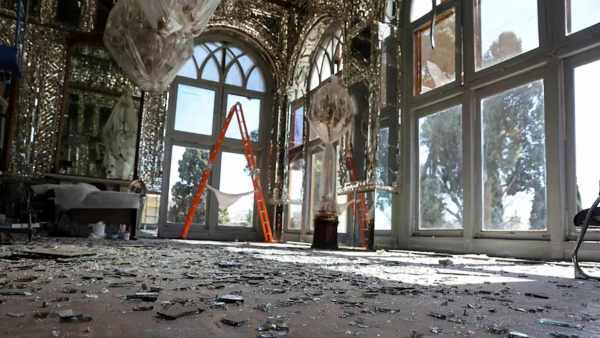 Debris at the Golestan Palace after the recent air strikes. (Reuters/File)
— It is a lavish monument of the Qajar era (1789 to 1925).
It

became a centre of Qajari arts and architecture, of which it is an outstanding example and has remained a source of inspiration for Iranian artists and architects to this day.
— The Golestan Palace is protected under international law, the 1954 Hague Convention for the Protection of Cultural Property in the Event of Armed Conflict.
Hague Convention of 1954 The Hague Convention of 1954, formulated under UNESCO, provides for the Protection of Cultural Property in the Event of Armed Conflict. The Convention was formulated with an aim to protect cultural property such as
|
2. Chehel Sotoun palace and the Masjed-e Jāme, :

The US and Israeli forces struck an ammunition depot in Iran’s Isfahan on March 31. Earlier, UNESCO confirmed damage to the 17th-century Chehel Sotoun palace and
the Masjed-e Jāme

the country’s oldest Friday mosque, both located in Isfahan.
— According to the UNESCO website, “the Masjed-e Jamé (‘Friday mosque’) can be seen as a stunning illustration of the evolution of mosque architecture over twelve centuries, starting in AD 841. It is the oldest preserved edifice of its type in Iran and a prototype for later mosque designs throughout Central Asia.


Comments
Post a Comment